ABOUT THE CARBON FORESTRY STANDARD

A certification scheme for carbon storage in actively managed forests

The Carbon Forestry Standard (CFS) is a certification scheme for carbon storage in actively managed forests. The standard establishes overarching requirements for additionality, quantification, long-term carbon storage and sustainability. It also governs the certification scheme’s administration, independent assessment, allocation of responsibilities, decision-making procedures and registry management. The associated methodology, Improved Forest Management – Sweden (IFM-Sweden), specifies how these requirements are applied under Swedish forestry conditions, including through project-specific baselines, quantification of carbon removals, monitoring and risk management. IFM-Sweden is currently the only approved methodology under the CFS.

How does the IFM methodology work?

THE CORE PRINCIPLE OF IFM SWEDEN

Carbon credits based on verified carbon removals

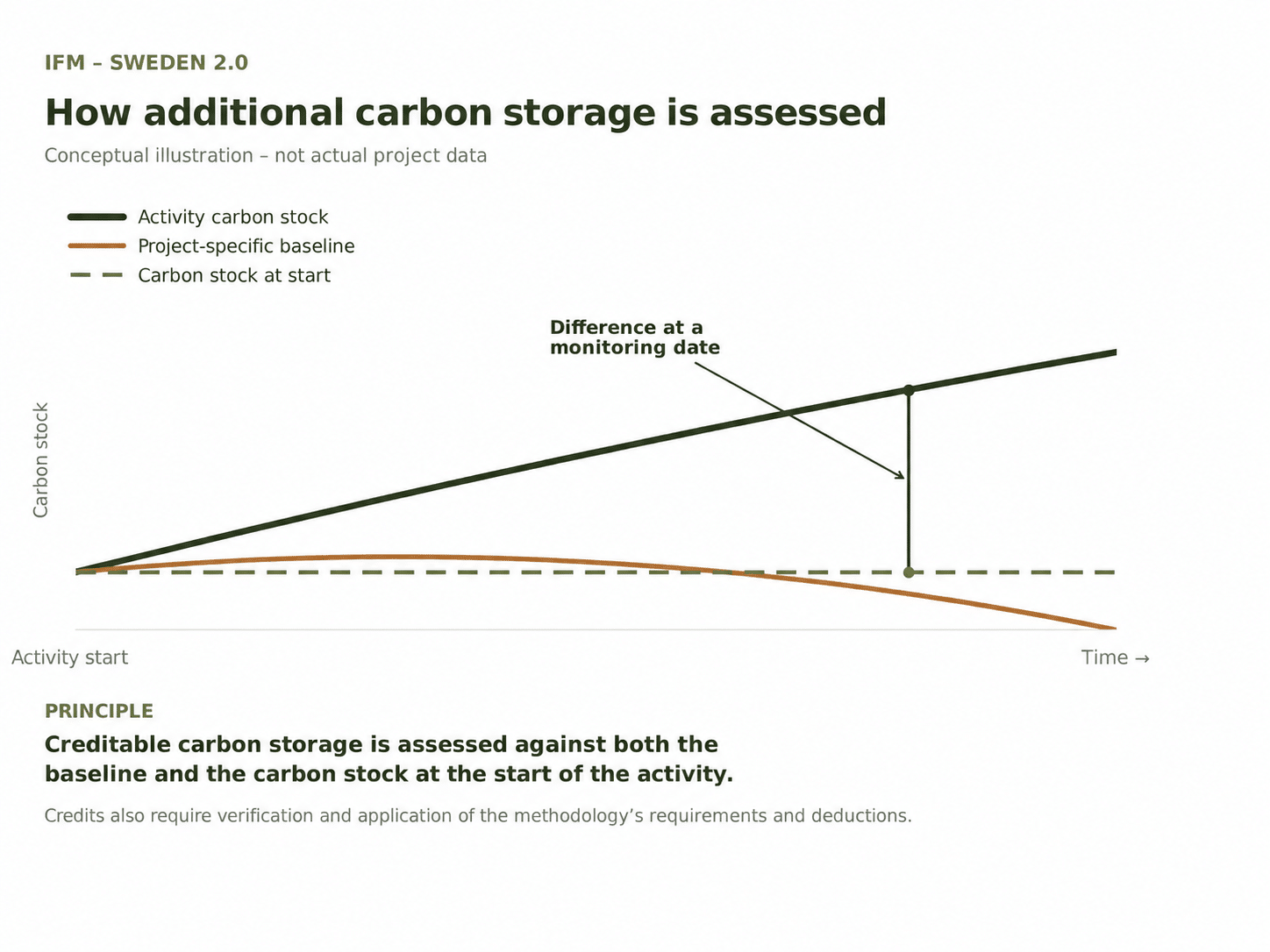
IFM Sweden covers the entire forest management unit and compares the development of its carbon stock with a project-specific baseline. Only carbon removals that meet the methodology’s requirements for additionality and verification can form the basis for issuing carbon credits.


PROJECT-SPECIFIC BASELINE

Describes how the forest’s carbon stock is expected to develop under economically rational forest management without revenue from carbon credits.

ADDITIONALITY

The measures must go beyond legal requirements and depend on an economic incentive provided by carbon credit revenue.

EX POST AND VERIFICATION

Carbon removals are quantified annually. Credits are issued only after independent verification and application of the methodology’s other requirements and deductions.

From forest project to certified carbon credit

01

Application and baseline

The operator prepares an activity plan and provides the information required to establish a project-specific baseline. As a general rule, the baseline is developed by an independent party in accordance with the methodology.

02

Validation and certification

Independent reviewers assess the project’s starting conditions, baseline and application of the methodology. Carbon Capture Company makes the certification decision following a documented assessment.

03

Implementation and monitoring

Forest management measures are implemented and changes in the forest’s carbon stock are monitored. Forest data, harvesting and compliance with the methodology’s requirements are documented on an ongoing basis.

04

Independent verification

Reported carbon removals are reviewed by independent verifiers. Periodic assessments are carried out in accordance with the methodology’s provisions.

05

Issuance and registration

Carbon Capture Company reviews the verification evidence and decides on issuance after applicable deductions and adjustments. Approved carbon credits are recorded in the registry to ensure traceability.

Quality requirements for credible carbon storage

01 / QUANTIFICATION AND UNCERTAINTY

Conservative calculations

Carbon storage is quantified using forest data and modelling. The methodology requires uncertainties to be handled conservatively, so that the certified climate benefit is not overestimated.

02 / LEAKAGE

Managing leakage risk

The methodology covers the entire forest management unit to prevent harvesting from being shifted within the holding. It also applies a conservative deduction for residual market leakage risk.

03 / LONG-TERM CARBON STORAGE

Risk management and liability

The methodology includes requirements for a guarantee stock, long-term monitoring and management of reversal risks. A buffer reserve covers certain unintentional losses, while non-compliance is addressed through specific liability requirements.

04 / SUSTAINABILITY AND BIODIVERSITY

Sustainable forest management

Certified activities must meet requirements for biodiversity, soil and water protection, and social safeguards. The forest’s long-term productive capacity must also be maintained or enhanced.

DEVELOPMENT OF THE STANDARD

Development and international application

The Carbon Forestry Standard has been developed with Nordic forestry conditions in mind, with one approved methodology for Swedish forests. The certification scheme’s structure allows for adaptation to other countries through country-specific methodologies that account for national differences in forest management, data availability, legislation and monitoring. Norway and Finland are examples of countries where such further development could be relevant. New or adapted methodologies are subject to separate review and approval. Currently, Improved Forest Management – Sweden (IFM-Sweden) is the only approved methodology under the Carbon Forestry Standard.

Current standard and methodology

STANDARD

Carbon Forestry Standard

Version 2.0

The current full text of the standard, setting out requirements for certification, quality assurance, governance and registry management.

METHODOLOGY

IFM – Sweden

Methodology 2.0

The current methodology for Improved Forest Management in Swedish forests, including rules for baselines, quantification, monitoring and verification.