CERTIFICATION IN PRACTICE

How it works

From forest management plans and baseline modelling to verified carbon removals and issued carbon credits: The Carbon Forestry Standard (CFS) establishes the requirements for certifying additional carbon removals in actively managed forests. Four illustrations explain how the forest management unit is defined, how changes in standing timber volume are calculated and verified, which deductions are applied and how risks are managed.
01 / FOREST MANAGEMENT UNIT

The forest management unit is the basis for certification

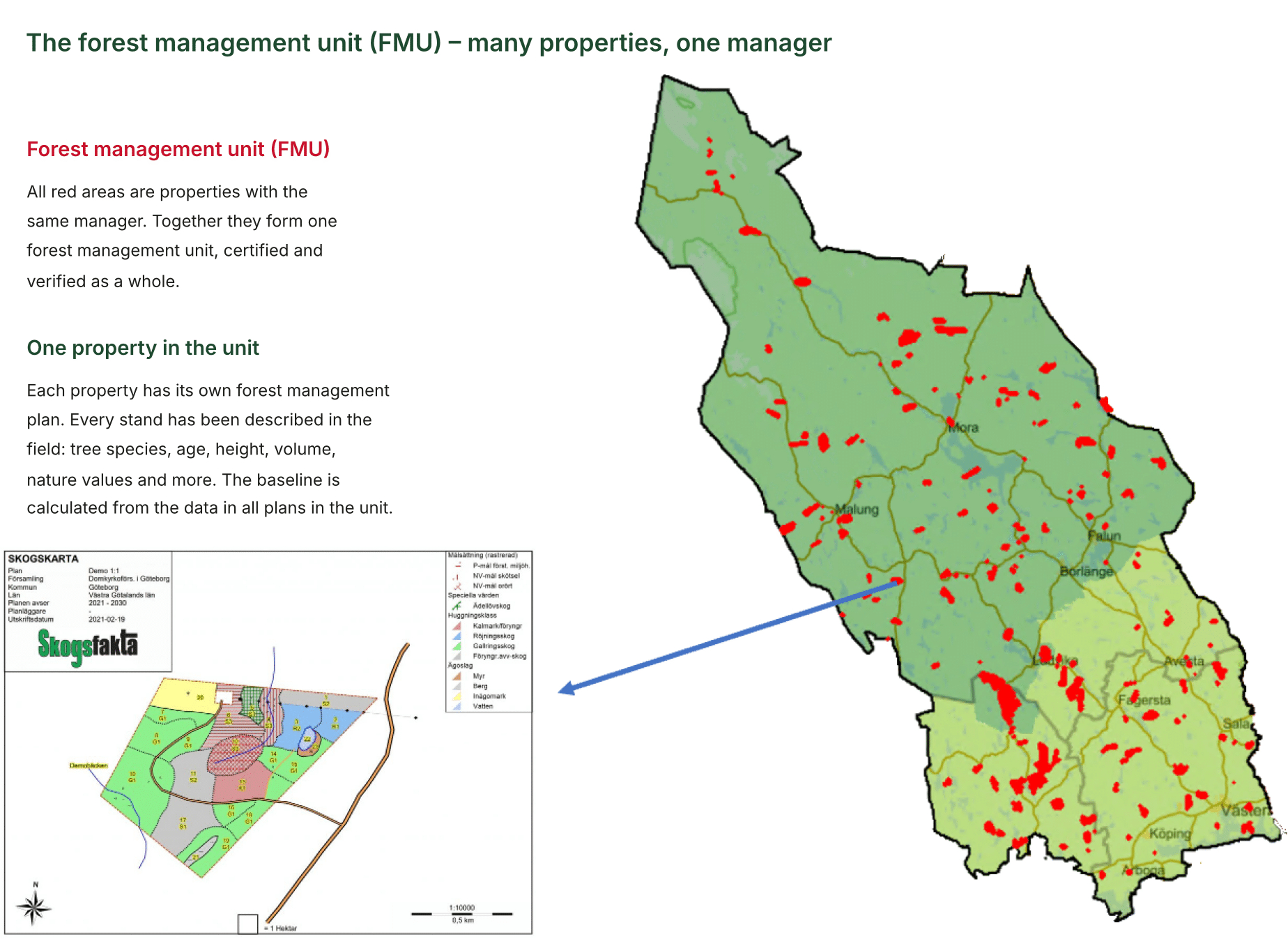
Certification covers the forest management unit as a whole, rather than selected stands or individual properties.

Illustration of a forest management unit comprising multiple properties and forest management plans

All properties managed by the same forest manager together form one forest management unit, which is certified and verified as a whole. Each property has its own forest management plan, containing detailed information on tree species, age, height, volume, biodiversity values and other characteristics. The baseline is calculated using data from all forest management plans within the unit.

02 / QUANTIFICATION AND VERIFICATION

How carbon removals are calculated and verified

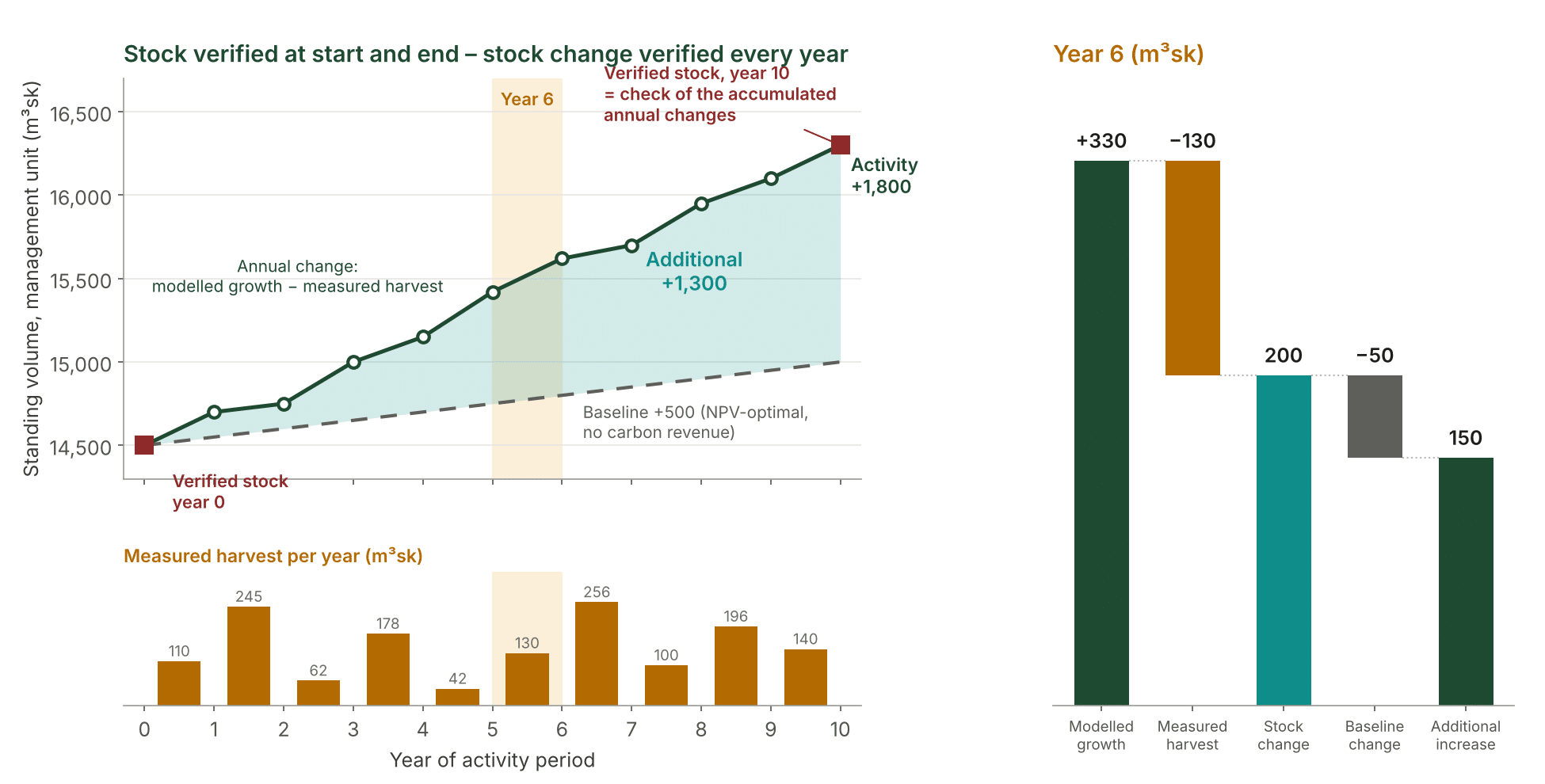
Annual changes in standing timber volume are calculated from modelled forest growth and measured harvesting. Additional carbon storage is determined by comparison with a baseline scenario.

Chart showing changes in standing timber volume, baseline development, annual harvesting and verification

Standing timber volume is measured and verified at the beginning of the activity period and again after no more than ten years. In between, annual changes are calculated as modelled growth minus measured harvest. Growth is estimated using a forest projection model such as Heureka, while harvesting is measured by Biometria. The additional increase is the difference from the baseline, representing economically optimal forest management without carbon revenues. The chart also illustrates the calculation for year six.

03 / QUANTIFICATION AND ISSUANCE

From verified carbon removals to saleable carbon credits

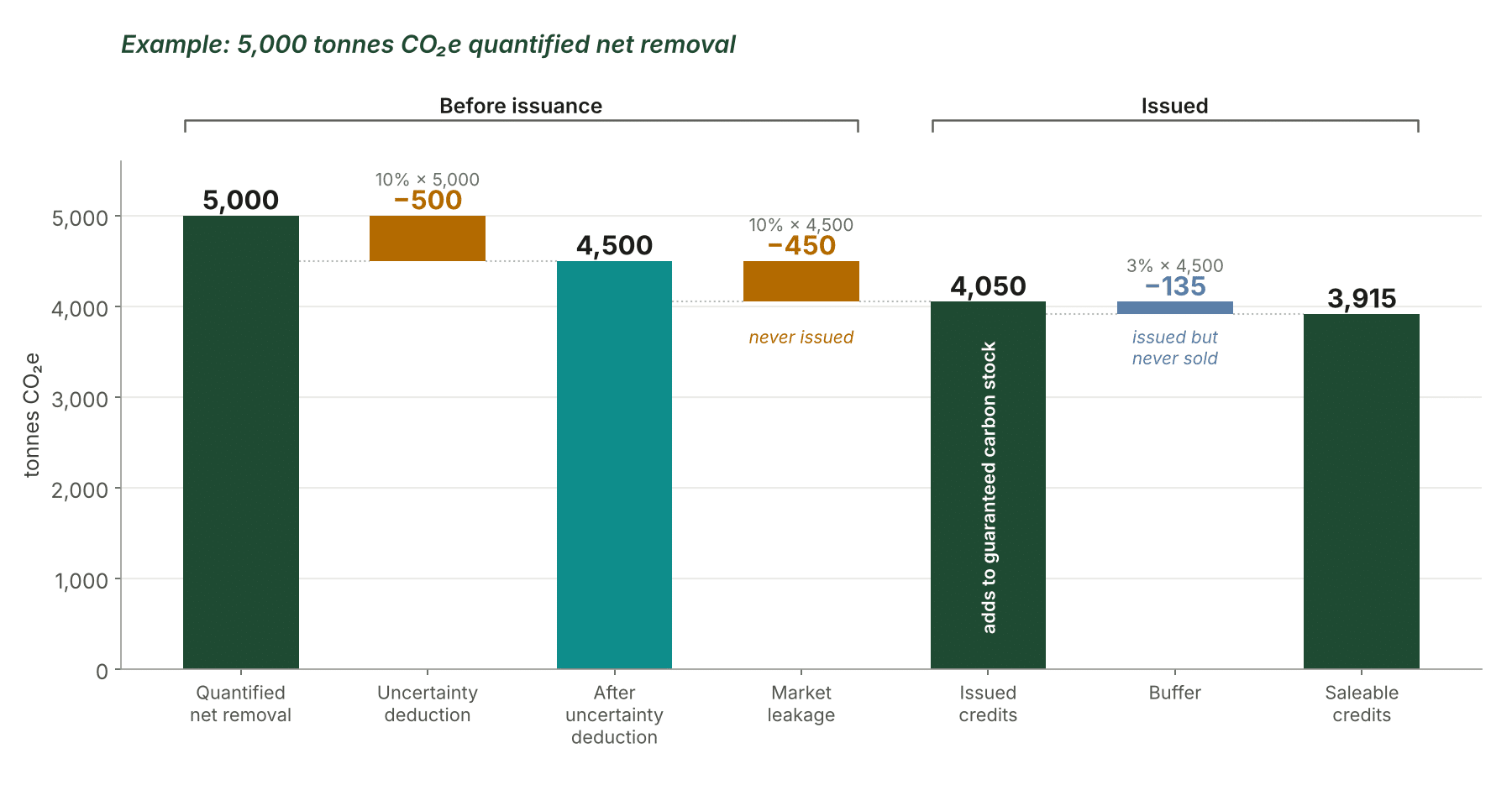
Not all quantified net carbon removals become saleable carbon credits. Deductions are applied for uncertainty and market leakage, and a proportion of issued credits is allocated to a risk buffer.

Example showing deductions and buffer allocation from 5,000 tonnes of quantified carbon dioxide equivalent

The example starts with 5,000 tonnes of CO₂e. An uncertainty deduction of 10% is applied first. A further 10% of the remaining amount is deducted for market leakage, addressing the risk that reduced harvesting in one location could increase harvesting elsewhere. These amounts are never issued as credits. In the example, a buffer allocation of 3% is then applied, and the corresponding credits are not sold. All issued credits contribute to the guaranteed carbon stock that the forest owner undertakes to maintain.

04 / RISK MANAGEMENT

How the risk buffer works

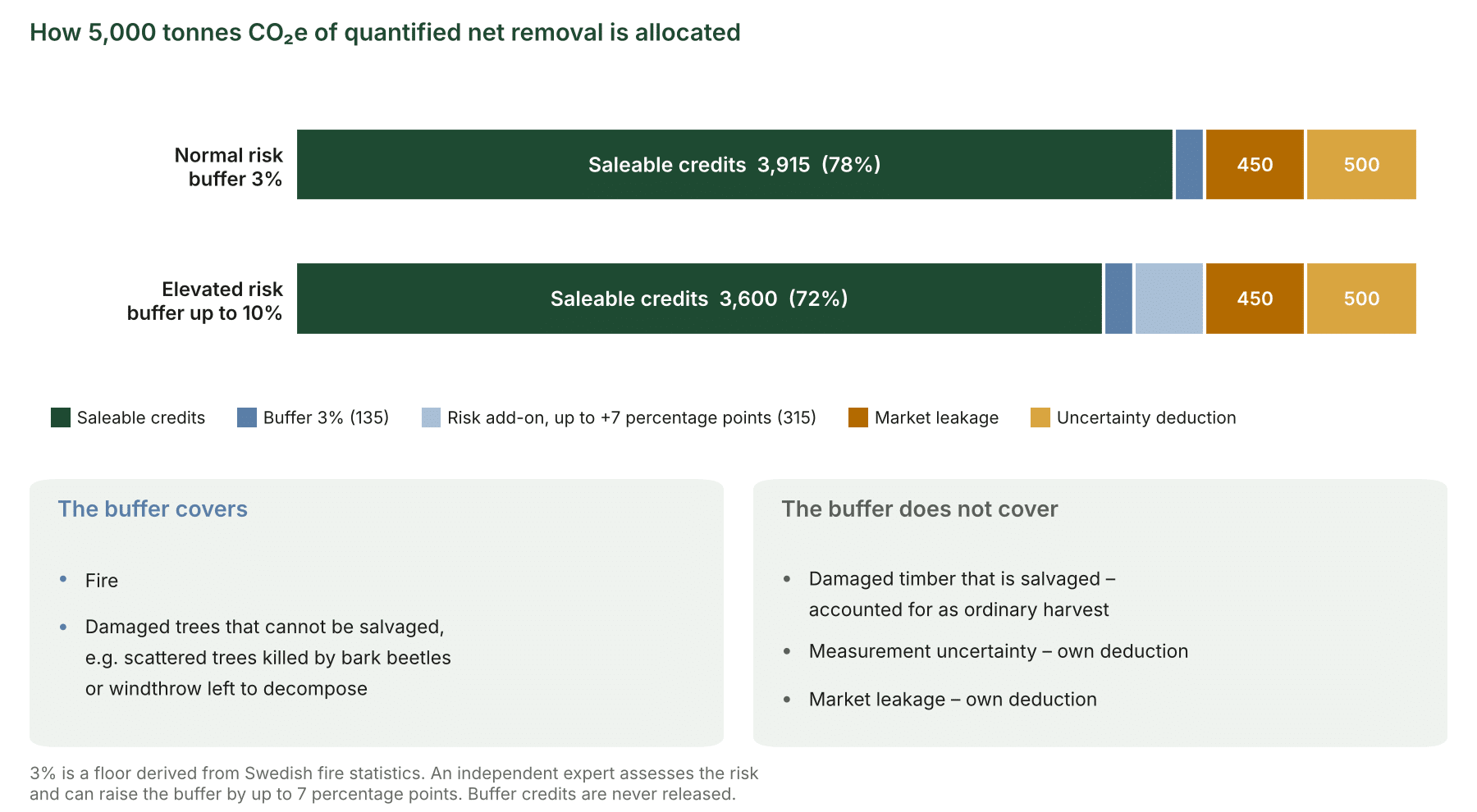
A proportion of issued credits is reserved to address certain losses of stored carbon. The size of the buffer is adjusted to reflect the risk profile of the individual forest management unit.

Diagram showing saleable credits and buffer allocations under normal and elevated risk scenarios

The buffer covers losses that cannot be accounted for as ordinary harvesting, including fire and damaged trees that cannot be salvaged. The base level is 3%, derived from Swedish fire statistics. An independent expert assesses the risk for each forest management unit and may increase the buffer by up to seven percentage points, to a maximum of 10%. Salvaged damaged timber is accounted for as ordinary harvesting and does not draw on the buffer. Buffer credits are never released.

FURTHER READING

Explore the requirements behind certification

These illustrations explain key elements of the certification process. The full requirements and calculation rules are set out in the Carbon Forestry Standard and its associated methodology, Improved Forest Management – Sweden.